Nordic Collaboration: CAISA x Nora.ai x WASP-HS
Nordic Academic AI Initiatives Formalize Collaboration on Social Sciences and Humanities in AI Research
Launch of NAIP-HS – Nordic AI Partnership for Humanity and Society
National academic AI initiatives in Sweden, Denmark, and Norway have signed a Memorandum of Understanding (MoU) to strengthen their collaboration and amplify the role of Social Sciences and Humanities (SSH) in AI research. The partnership aims to create a unified Nordic voice that can advise policy makers and ensure that the transformative effects of AI on society is aligned with human-centric and democratic values. The leaders of the partners met in Oslo on 8 June, 2026, to sign the MoU.
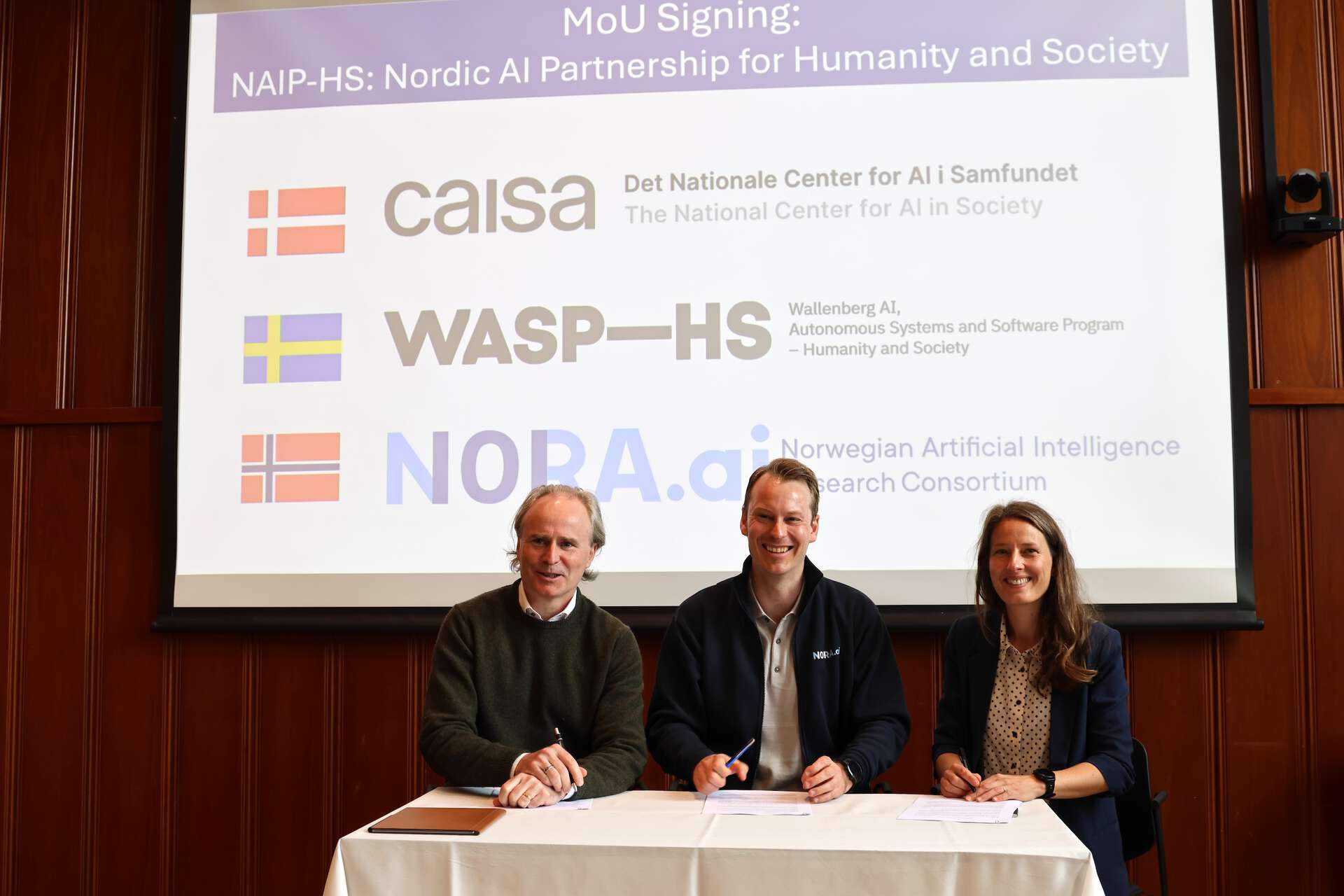
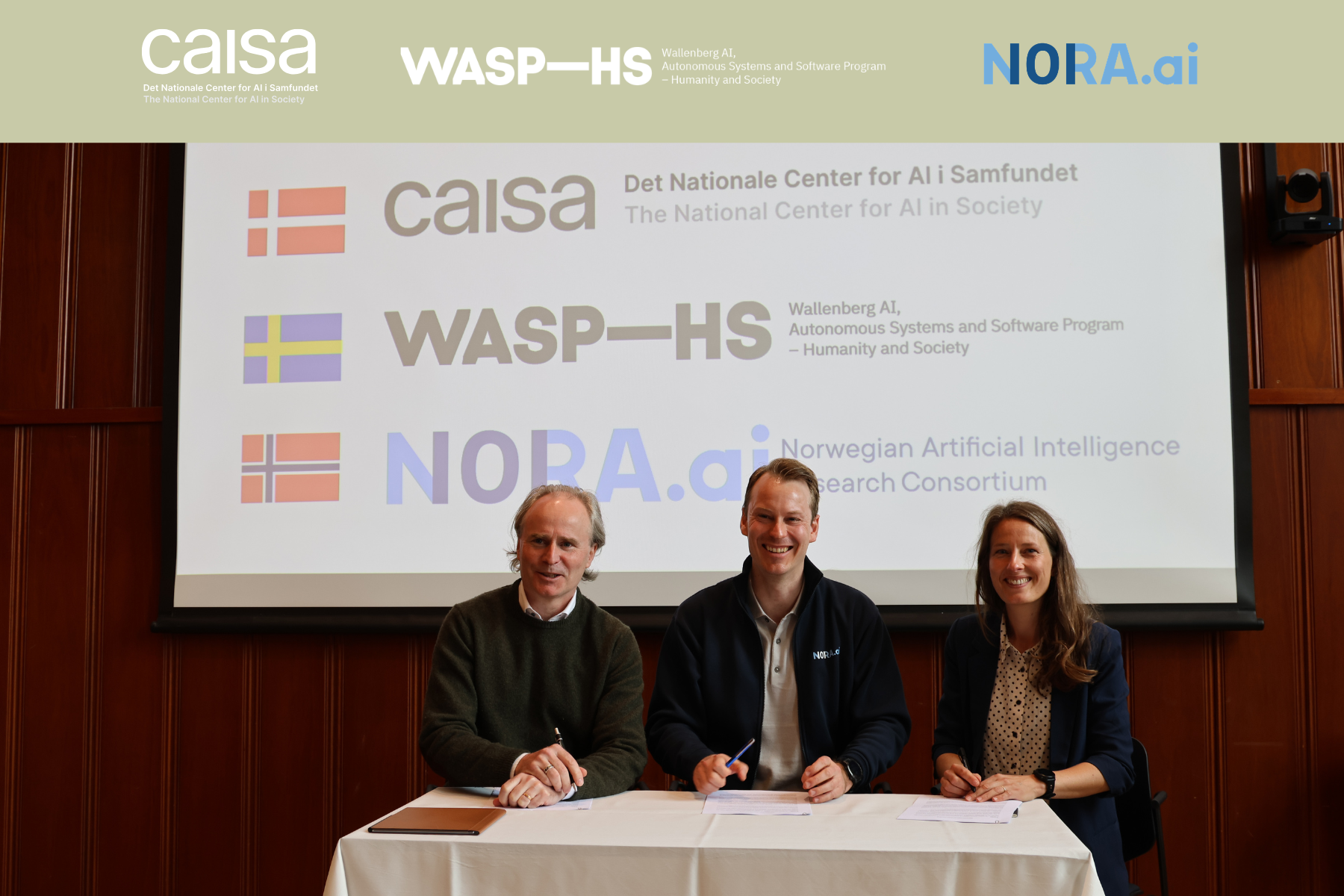
The agreement unites Sweden’s WASP-HS (The Wallenberg AI, Autonomous Systems and Software Program – Humanity and Society), Denmark’s CAISA (the National Centre for Artificial Intelligence in Society), and Norway’s NORA (Norwegian Artificial Intelligence Research Consortium). Together, these institutions aim to consolidate existing efforts within the three countries, creating a stronger, unified voice for SSH in AI research and education.
The Scandinavian countries share deep cultural, historical, and political ties that have fostered strong regional collaboration and mutual trust. Together, they form a region characterized by high standards of living, comprehensive welfare systems, and a strong commitment to democracy, inclusion, and human rights. SSH research plays a crucial role in ensuring that the development and adoption of AI remain aligned with these shared societal values.
The agreement establishes a Scandinavian collaboration on SSH perspectives in AI, while building on the broader Nordic AI Partnership, formalized through an existing MoU between the Norwegian NORA, the Swedish WASP (The Wallenberg AI, Autonomous Systems and Software Program), the Danish Pioneer Centre for AI (P1), The Finnish FCAI (Finnish Center for Artificial Intelligence), and the Icelandic CADIA (Center for Analysis and Design of Artificial Agents). While that collaboration primarily connects leading technical AI environments across the Nordic region, the new agreement strengthens collaboration on the SSH dimensions of AI, helping bridge the gap between technical AI research and Social Sciences and Humanities perspectives. Going forward, the Nordic AI Partnership will provide the parties with a basis for expanding the SSH-MoU into a Nordic collaboration that includes Finland and Iceland.
A key mission of the collaboration is bridging the gap between researchers and policymakers. By working together, the partners seek to ensure that politicians and decision-makers in the Nordic countries receive expert advice and evidence-based recommendations on the societal and ethical implications of artificial intelligence.
The Nordic AI Meet, a scientific conference launched by NORA in 2021 and funded by the Research Council of Norway since 2022, plays a central role in this effort. Designed to support young researchers, the conference provides a platform for sharing knowledge, fostering collaboration, and building connections between academia and society. With Denmark hosting in 2023, Finland in 2024, Sweden in 2025, and Iceland hosting from October 14 to 15 in 2026, the conference has become a cornerstone of Nordic AI cooperation and visibility.
From 2026, the Nordic AI Meet will be funded through the Norwegian AI Research School for Humanities and Society, NORA-HS. The idea of the current MoU emerged from a collaboration between NORA-HS and the Graduate School of WASP-HS. The MoU expands this collaboration and lifts it to a higher level by formalizing a partnership and strengthening the Nordic AI Meet as a platform for unified communication both from the technical and SSH sides of AI research. By consolidating resources and expertise, the collaboration aims to enhance academia’s visibility and influence in society, ensuring the Nordic region leads in addressing the challenges and opportunities of artificial intelligence.
The signing of the MoU marks a significant milestone for SSH research within the Nordic AI ecosystem, setting the stage for closer collaboration, stronger academic representation, and a lasting impact on the development and application of artificial intelligence.
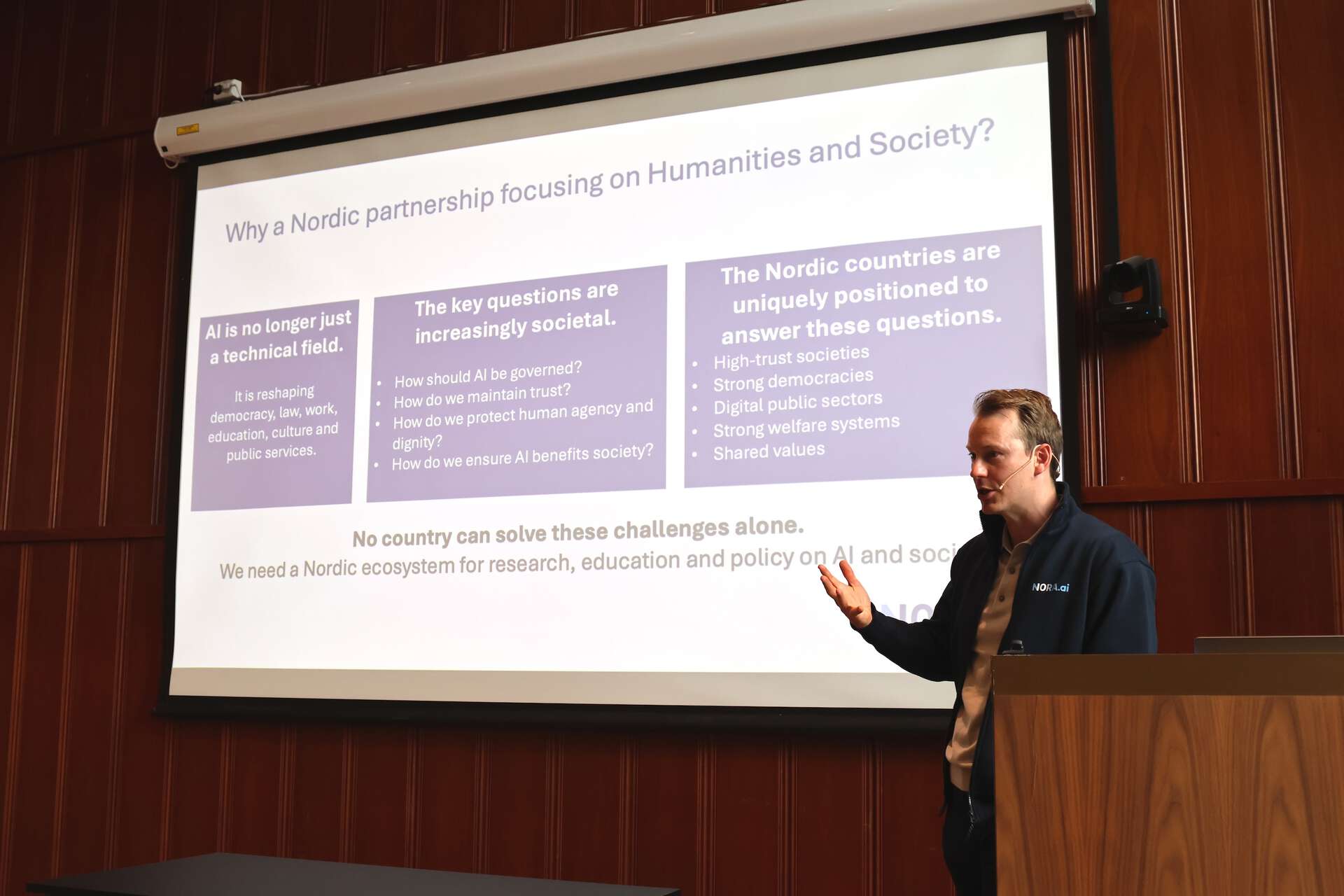
The leaders of the partners see this collaboration as a key milestone for both academia and society. Here’s what they have to say about the initiative:
Christofer Edling, Program Director at WASP-HS: AI is transforming not only technology, but society as well. We look forward to working closely with our Nordic partners to ensure that perspectives from the humanities and social sciences remain at the forefront during this unprecedented time.
Stine Lomborg, Chief Scientist at CAISA: As AI becomes increasingly embedded in our personal lives, work, and societal institutions, there is an urgent need to understand its transformative capacity. Nordic collaboration will be key to bringing SSH insights to the fore, developing talent in research and education, and steering developments of AI in society to ensure they benefit us all.
Michael Solvang, CEO of NORA: The Norwegian ‘AI Billion’, which has now materialised into six national AI centres, recognised from the beginning that AI is not only about technology, but also about its societal consequences. To meet the need for SSH competence in this area, NORA established the NORA-HS research school, inspired by WASP-HS. Building on that experience and the Nordic AI Partnership, we saw an opportunity to strengthen Nordic collaboration on AI and society. We are therefore very proud to take this first step together through NAIP-HS. I also see this as a small, but important, contribution to strengthening AI Sovereignty through Nordic collaboration.

Through six interventions from leading European scholars in their field, this research brief examines the challenges of governing AI-generated content in an information environment where such content is rapidly becoming the norm. Drawing on interdisciplinary perspectives, the contributions assess the effectiveness and limitations of emerging AI transparency governance, particularly labelling requirements under the EU AI Act and the forthcoming Code of Practice on marking and labelling of AI-generated content. While transparency labels are normatively important for informing users about content provenance, research suggests that labelling alone is unlikely to mitigate manipulation, restore trust, or empower citizens. The research brief therefore argues for a broader transparency ecosystem that combines labelling with governance infrastructure, organisational accountability, and ongoing research to develop adaptive, evidence-based approaches to AI transparency.
Artificial intelligence has moved to the very center of Danish politics. During the government negotiations at Marienborg in April 2026, the talks were temporarily paused so that senior politicians could attend a seminar on AI and its societal implications.
At the seminar, CAISA Director Rebecca Adler-Nissen, together with Professor Abraham Newman (Georgetown University), contributed research-based perspectives on the role of AI in geopolitics, the economy, and democracy. Their presentation addressed, among other issues, how artificial intelligence affects security, labor markets, education, and Europe’s strategic position.
According to TV2, there was strong interest among the politicians, who actively engaged with questions related to both technological developments and societal consequences. Rebecca Adler-Nissen highlighted the high level of engagement and the growing demand for knowledge about the implications of AI across policy areas.
CAISA’s participation underscores the center’s role in bringing research-based knowledge into political decision-making processes and contributing to the responsible development of AI in society.
This brief is currently only available in Danish.
Summary (Translated)
Digital sovereignty is multidimensional and requires priority
In a time of geopolitical instability and rapid AI development, control over digital infrastructure and data has become critical. While there is broad agreement on the need for action at the national, Nordic, and EU levels, a shared language around digital sovereignty is still lacking. This lack of alignment leads either to inaction or to narrow technical solutions without strategic direction. The core argument of the brief is that digital sovereignty is a multidimensional concept, involving both principled positions and pragmatic choices. Reducing it to technical solutions risks overlooking the values and trade-offs that determine who controls and benefits from these systems. Conversely, focusing solely on values leads to abstract principles without practical implementation or real impact. Digital sovereignty is rarely about choosing between full self-sufficiency and total dependence. Rather, it is about balancing often competing demands for openness, security, competitiveness, growth, values, and rights in a world where capabilities are unevenly distributed. This means that it is necessary to define who or what is to be protected or promoted, within the domains of security, economic growth, or citizens’ rights, and to recognize that choices in one domain may strengthen or undermine another. The brief focuses on AI as the area where digital sovereignty is most acutely at stake, but the concepts apply more broadly to digital infrastructure and data. It provides decision-makers with tools to navigate these dilemmas by presenting:
- A conceptual framework for identifying who or what should be digitally sovereign.
- An overview of how digital sovereignty is prioritized around the world.
- An understanding that sovereignty can be exercised through three control regimes: ownership, expertise, or regulation – but that none of these are sufficient on their own.
The central implication of the brief is that digital sovereignty requires an integrated strategy that combines ownership, expertise, and regulation, while managing the interdependencies and trade-offs between security, economic growth, and citizens’ rights through clear objectives. Without this holistic approach, there is a risk of ineffective regulation, unusable infrastructure, or a lack of capacity to develop, maintain, and apply solutions in practice, potentially undermining security, growth, or rights.